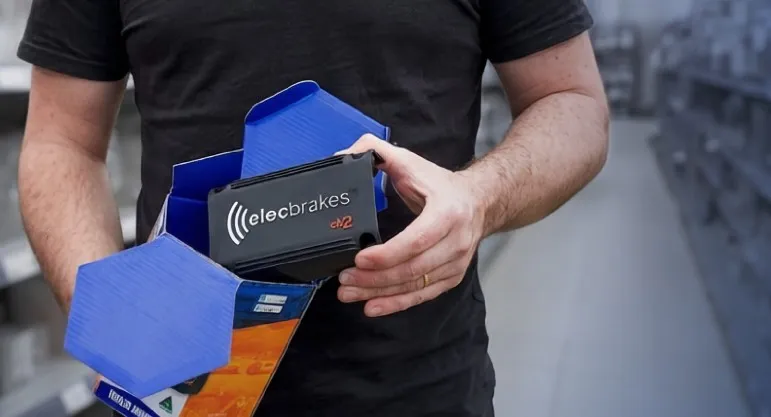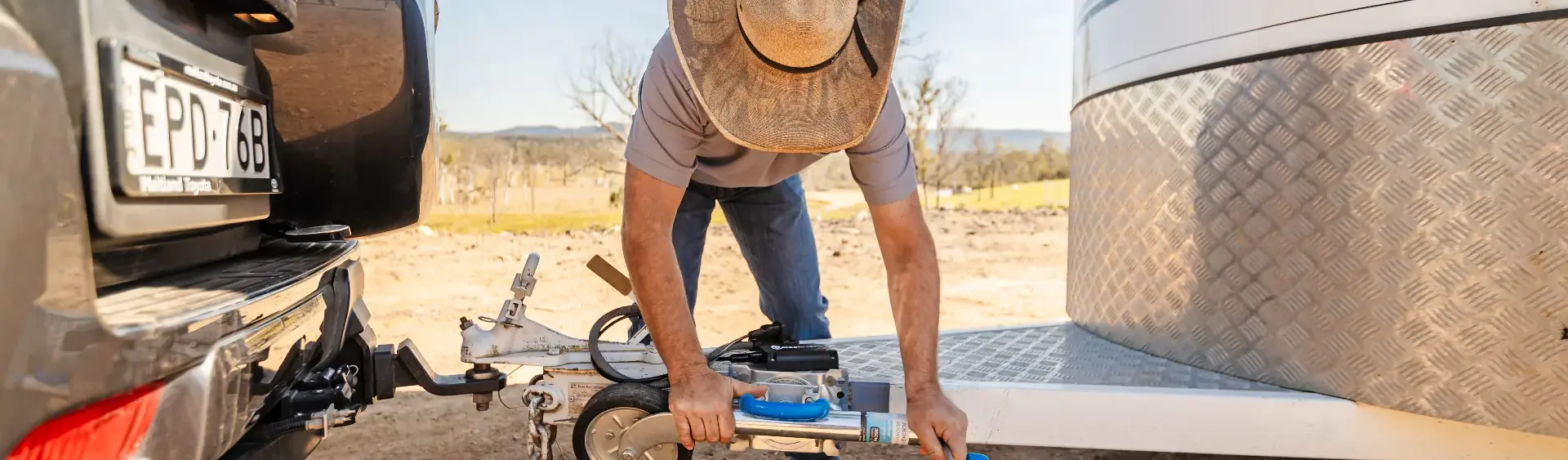
Electric Brake Controllers: What Are They And How Do They Work?
Published:
15 min read
Australia’s Leading Guide to Electric Brake Controllers for Caravans, Tool Trailers, Boat Trailers and More
What Is An Electric Brake Controller?
At its core, an electric brake controller is a smart electronic device that activates and manages your trailer’s braking system, delivering safe, smooth, and synchronised stopping power in tandem with your tow vehicle.
In Australia, trailers over 750kg are legally required to have a compliant braking system. For trailers up to 4500kg, an electric or electric-over-hydraulic setup provides the control and safety needed on the road.
Whether you’re towing a caravan, box trailer, horse float, or boat trailer, an electric brake controller ensures consistent braking every time.
Electric brake controller quick answers
| Question | Answer |
|---|---|
| What is an electric brake controller? | An electric brake controller is an electronic device that activates and controls your trailer’s electric brakes in sync with your tow vehicle, providing safe and proportional braking. |
| Do I need a brake controller in Australia? | Trailers over 750kg GTM must have a compliant braking system under ADR38. For trailers over 2000kg GTM, the brakes must be driver-controlled from the tow vehicle, which typically requires an electric brake controller. |
| How does an electric brake controller work? | An electric brake controller detects when you apply your vehicle brakes and automatically applies proportional braking to the trailer’s electric brakes, helping the vehicle and trailer stop smoothly together. |
| What’s the difference between EB2 and VM1? | The EB2 brake controller mounts directly on the trailer and can be used with multiple tow vehicles, while the VM1 installs on the tow vehicle and can control multiple trailers. |
| What trailers use electric brake controllers? | Electric brake controllers are commonly used with caravans, boat trailers, horse floats, trade trailers and many commercial trailers that are equipped with electric brakes or electric-over-hydraulic brake systems. |
| Are electric brake controllers easy to install? | Some modern systems, like Elecbrakes EB2, feature plug-and-play installation and can be fitted to the trailer in around 10 minutes without modifying the tow vehicle dashboard. |
Understanding Electric Brake Controllers
Electric brake controllers are the link between your tow vehicle and your trailer’s braking system. Rather than relying on manual input or guesswork, these devices automatically adjust trailer braking based on how the vehicle is slowing down.
Advanced products like Elecbrakes’ EB2 and VM1 go a step further, using accelerometer technology to analyse movement in real time, recalculating braking output up to 1,000 times per second. This ensures balanced, proportional braking across both vehicle and trailer, reducing the risk of jolts or brake lock-up.
Types Of Electric Brake Controllers
Not all brake controllers are created equal. Understanding the differences is key to choosing the right setup for your towing needs.
Time-based controllers apply a predetermined braking force when the tow vehicle slows. While simple and cost-effective, they lack the responsiveness and adaptability required for heavier loads or varied terrain.
Surge brakes (also known as override or overrun brakes) operate mechanically or hydraulically through a sliding coupling. While commonly used in smaller or older trailers, they offer limited control and are unsuitable for larger caravans or anything carrying precious cargo.
Proportional controllers like Elecbrakes represent the most advanced option. These systems monitor your vehicle’s actual deceleration and instantly calculate the precise braking force required for your trailer. The result is seamless, coordinated stopping that feels natural and controlled, making them ideal for everything from weekend getaways to professional towing setups.
Types of trailer brake controllers compared
| Type | How It Works | Best For | ADR38 Compliant? |
|---|---|---|---|
| Time-based | Applies a fixed, pre-set braking force whenever the tow vehicle brakes. Braking increases over a set time rather than responding to vehicle deceleration. | Lighter towing setups, budget installations and unique off-road conditions. | Allowed for some electric brake systems under 2,000kg GTM, but less responsive than proportional controllers. These enable compliance, only if they allow the driver to increase and decrease braking in normal driving conditions. |
| Surge / Override | Mechanical or hydraulic system where a sliding coupling activates the trailer brakes using inertia when the tow vehicle slows. No electrical connection required. | Boat trailers and smaller trailers | Enables compliance for trailers up-to 2000kg GTM. |
| Proportional / Inertia-based | Uses an accelerometer to measure vehicle deceleration and automatically applies matching braking force to the trailer. Adjusting up or down in real time. | Caravans, horse floats, boat trailers and similarly heavy towing setups | Fully compliant when installed correctly. |
| Trailer-mounted (Elecbrakes EB2) | A proportional brake controller installed directly on the trailer. Wired to the existing electrical circuit, it communicates via Bluetooth® wireless technology with the Elecbrakes smartphone app and adjusts braking automatically. | Ideal when one trailer is towed by multiple vehicles. Quick plug-and-play installation with no vehicle modifications. | Fully enables compliance with ADR38/05 requirements. |
The Benefits Of Proportional Technology
While many braking systems rely on direct input from the tow vehicle’s brake pedal, proportional brake controllers operate independently, responding to changes in speed and motion via internal sensors.
What sets them apart is their ability to interpret real-time inertia, adjusting braking force based on how the vehicle behaves, not just when the brakes are pressed. This not only enhances safety but also reduces wear on both the vehicle and trailer brakes.
This technology shines in real-world scenarios where traditional controllers fall short. Picture descending a steep hill while engine braking in a lower gear. A proportional electric brake controller like Elecbrakes’ features Dynamic Slope Compensation which detects the deceleration and automatically engages the trailer brakes to maintain stability, even though you haven’t touched the brake pedal.
This intelligent behaviour is invaluable for navigating Australia’s diverse terrain, from winding mountain roads to long highway stretches.
Discover Elecbrakes Brake Controllers
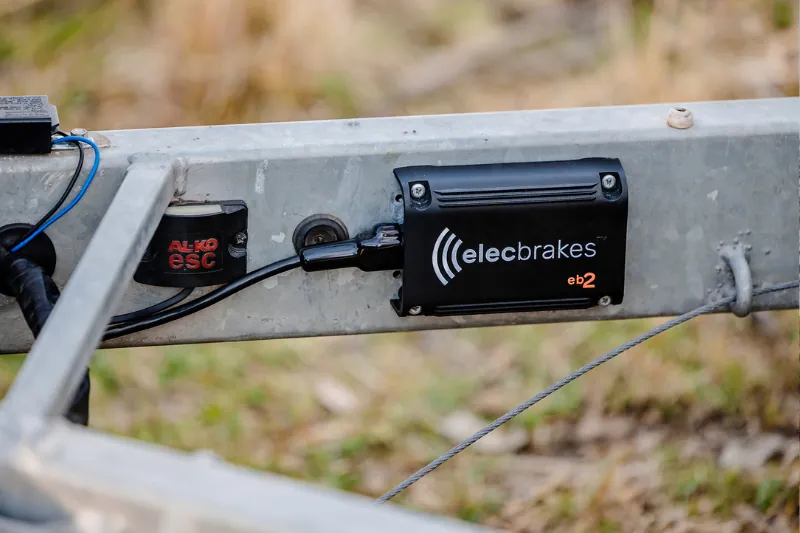
Elecbrakes currently design and manufacture two electric brake controllers - the EB2 and VM1, each offering distinct benefits for different uses.
EB2 Trailer-Mounted System Specifications
The EB2 sets a new standard in trailer-mounted brake controllers. Designed for ultimate flexibility, it mounts directly to the drawbar of the trailer, allowing it to be towed by multiple vehicles.
With the Plug + Play adaptor, installation takes less than 10 minutes and requires no wiring knowledge. The EB2 draws power from the trailer’s existing tail and brake light circuits, or from auxiliary and brake circuits.
Technical Specifications:
- Operating Voltage: Works with 12V and 24V systems
- Integration: Apple CarPlay and Android Auto compatible
- Axle Support: When provided with a 12-24V DC dedicated power supply (wired with auxiliary) the EB2 can support up to 3 braked axles
- Construction: Fibre-reinforced housing with urethane-encased electronics
- Environmental Rating: IP67-rated dust, water and shock proof
- Dimensions: 14x9cm compact form
- Memory: Stores 5 customisable pre-set programs
- Seamless installation: Plug + Play install. No modifications to the dashboard
- Built in SwayControl
Learn more about EB2 → Discover EB2
VM1 Vehicle-Mounted System Specifications
The VM1 brake controller is wired into your tow vehicle, providing consistent, responsive braking across multiple trailers, without the need for extra gear on each one.
It draws power from your vehicle’s auxiliary circuit, and when not in use, automatically enters sleep mode to preserve battery life. It’s a seamless, set-and-forget solution for those who tow regularly and demand reliable performance.
Technical Specifications:
- Operating Voltage: Works with 12V and 24V systems
- Integration: Apple CarPlay and Android Auto compatible
- Axle support: When provided with a 12-24V DC dedicated power supply operates up to 3 braked axles
- Construction: Fibre-reinforced housing with urethane-encased electronics
- Environmental Rating: IP67-rated dust, water and shock proof
- Dimensions: 14x9cm compact form
- Memory: Stores 5 customisable brake settings
- Seamless installation: Professional installation is recommended. No modifications to the dashboard
- Built in SwayControl
Learn more about VM1 → Discover VM1
Installation Requirements
The EB2 installation process follows a clear sequence using the Plug + Play adaptor. The unit mounts to the trailer’s chassis rails or drawbar, on the top, side, or bottom positioning while maintaining level orientation, with the adaptor connecting your vehicle to the trailer socket.
VM1 installation requires professional installation to ensure proper vehicle integration. This process includes:
- Mounting the unit to a safe, but accessible part of the vehicle
- Integration with vehicle electrical systems
- Connection to brake control circuits
Elecbrakes App Integration
Available for both Apple and Android, the app allows you to easily customise brake response with precise settings. Drivers can select up to five pre-set programs to suit different driving conditions, from highway cruising to off-road towing.
All settings are stored directly in the brake controller’s memory, so once your preferences are saved, they remain with the brake controller, not the phone. This makes it easy for others to tow with confidence. Whether it’s a friend borrowing your trailer or a rental user, they simply download the free app, connect via Bluetooth® wireless technology, and they’re ready to go.
Choosing the Right Brake Controller
While both the VM1 and EB2 are premium electric brake controllers, they’re designed for different towing needs:
- Mounting Location: VM1 is installed on the tow vehicle. EB2 is installed on the trailer.
- Ideal Use Case: VM1 is best for one vehicle towing multiple trailers. EB2 is ideal for one trailer being towed by multiple vehicles.
- Installation Style: VM1 is professionally installed using the vehicle’s trailer circuits. EB2 is a DIY Plug & Play system that installs in around 10 minutes.
| Feature | EB2 (Trailer-Mounted) | VM1 (Vehicle-Mounted) |
|---|---|---|
| Mounting Location | Installed on the trailer | Installed on the tow vehicle |
| Ideal Use Case | One trailer towed by multiple vehicles | One vehicle towing multiple trailers |
| Installation Style | DIY Plug & Play - approx. 10 minutes | Requires wiring into the vehicle’s electrical circuits. Follow the provided install guide or consult with an auto electrician. |
| Operating Voltage | 12V and 24V | 12V and 24V |
| Axle Support | Up to 3 braked axles | Up to 3 braked axles |
| Connectivity | Via App, Apple CarPlay + Android Auto or Optional Remote | Via App, Apple CarPlay + Android Auto or Optional Remote |
| Environmental Rating | IP67 — dust, water and shock proof | IP67 — dust, water and shock proof |
| Dimensions | 14 x 9 cm compact form | 14 x 9 cm compact form |
| Brake Settings | 5 customisable programs | 5 customisable programs |
| Dashboard Modifications | None required | None required |
| SwayControl | Yes | Yes |
| Over-the-air Updates | Yes | Yes |
| ADR38 Compliant | Yes | Yes |
Compare VM1 and EB2 → See full comparison guide
What’s Right For Your Load?

Caravan Towing
Whether you’re off on a weekend getaway or managing a rental fleet, both the EB2 and VM1 offer excellent braking support for caravans. The EB2 is ideal for shared or hire caravans. Simply hitch up and go, no hardwiring needed. For those with a dedicated tow vehicle, the VM1 integrates seamlessly, offering a more permanent, on-vehicle solution.
Commercial Applications
For businesses that rely on trailers, both controllers offer flexibility and control. The EB2 is perfect for fleet sharing, letting multiple drivers use the same trailer without additional setup. Meanwhile, the VM1 suits vehicles that tow multiple trailers regularly, delivering a consistent, hardwired braking experience whatever you’re towing.
Horse Float Transport
Towing livestock requires smooth, predictable braking, and both Elecbrakes systems deliver just that. Adjustable brake profiles help tailor the response to different load weights, while dynamic slope detection ensures stability when navigating hilly or uneven terrain. It’s peace of mind for both horse and handler.
Boat Trailers
Towing in marine environments comes with its own set of challenges, but the EB2 and VM1 are built to handle them. Both feature sealed, weather-resistant construction, ideal for reversing down wet ramps or dealing with splashes and spray.
System Monitoring And Maintenance
Elecbrakes brake controllers wirelessly connect with your smartphone via the Elecbrakes app, giving you real-time visibility into brake performance and system status.
Both the EB2 and VM1 offer advanced monitoring features, with smart sensors that track brake response, log usage history, and alert you to any maintenance needs so you can stay on top of servicing before issues arise.
With Apple CarPlay and Android Auto compatibility, you can access key performance data directly from your vehicle’s dashboard, keeping you informed without distraction.
Australian Compliance Standards
ADR38 legislation mandates specific requirements for trailer braking systems based on Gross Trailer Mass (GTM). Both the EB2 and VM1 meet these requirements across all Australian states. For trailers between 750kg and 2,000kg GTM, both systems provide the mandatory progressive brake force adjustment capability.
For trailers exceeding 2,000kg GTM, Elecbrakes brake controllers support integration with required breakaway systems. These safety mechanisms ensure trailer braking activates independently if separation occurs during transit. Each of our systems maintain the mandatory 15-minute emergency brake activation capability.
Trailer brake requirements in Australia by GTM
| GTM Range | Brake Requirement | Controller Required? | Notes |
|---|---|---|---|
| Under 750 kg | Check vehicle compliance plate. Not legally mandated (good practice to install) | Depends on tow vehicle specifics | Many lighter trailers operate without brakes, but installing trailer brakes can improve safety, especially when towing heavier loads or long distances. |
| 750 kg – 2,000 kg | Brakes required on at least one axle, all wheels on that axle | Required if using electric brakes | Surge (override) brakes do not require a brake controller. Electric brake systems require a compatible brake controller to operate. ADR38 compliance is judged on the entire trailer brake system. |
| Over 2,000 kg | Brakes required on all wheels and axles. | Required | A breakaway system is mandatory and must hold the trailer brakes engaged for at least 15 minutes. Some states, including NSW, require the tow vehicle to charge the breakaway battery and provide a warning device visible to the driver. |
Advanced Safety Features
Each of our products incorporate sophisticated safety measures. Continuous sensor monitoring ensures proper brake response while providing immediate feedback through the mobile interface, while our Dynamic Slope Compensation automatically adjusts brake force based on terrain, providing enhanced control on hills and varying road surfaces.
Support And Updates
Both controllers receive regular ‘over-the-air’ system updates to maintain optimal performance. These updates ensure continued compatibility with new vehicles and trailers, meaning you’ve always got the latest tech and features on your side.
Proudly Designed and Made on the Central Coast
At Elecbrakes, being “Australian made” is more than just a label—it’s a commitment. Based on the Central Coast, we design and manufacture our brake controllers locally, ensuring each unit meets the highest standards of quality and durability. Built to withstand Australia’s toughest road conditions, both the EB2 and VM1 represent our dedication to innovative, reliable towing solutions you can trust.
Electric brake controller FAQs
8 questionsAn electric brake controller is an electronic device that manages the braking force applied to a trailer’s electric brakes. It works in sync with the tow vehicle’s braking system, ensuring the trailer slows down smoothly and safely whenever the vehicle brakes are applied. Electric brake controllers are commonly used when towing caravans, boat trailers, horse floats and similarly heavy trailers.
In Australia, trailers with a Gross Trailer Mass (GTM) over 750kg must have a compliant braking system under ADR38 regulations. For trailers exceeding 2000kg GTM, the braking system must be controlled from the tow vehicle, which typically requires an electric brake controller.
A proportional brake controller uses sensors to detect how quickly the tow vehicle is slowing and applies an appropriate braking force to the trailer. This creates smooth, balanced braking.
A time-based brake controller applies a preset braking force whenever the vehicle brakes, gradually increasing braking force over time. While simpler, time-based systems are largely considered as older technology and cannot meet the performance of modern proportional brake controllers.
ADR38 is an Australian Design Rule that sets out the legal requirements for trailer braking systems. It defines how trailer brakes must perform, when braking systems are required, and how they must operate for different trailer weights. Electric brake controllers help vehicles meet these requirements, but ADR38 compliance is judged on the entire trailer brake system.
Yes, depending on the type of brake controller. Trailer-mounted controllers can be used with multiple tow vehicles because the controller stays attached to the trailer.
Trailers over 750kg GTM must have a braking system. Once a trailer exceeds 2000kg GTM, the braking system must be driver-controlled from the tow vehicle. This is where an electric brake controller is typically required to manage the trailer’s electric brakes.
A breakaway system is a safety mechanism that automatically applies the trailer brakes if the trailer becomes disconnected from the tow vehicle. In Australia, trailers over 2000kg GTM must have a breakaway system that can hold the trailer brakes engaged for at least 15 minutes.
Electric brake controllers are easier to install than many people expect. While some vehicle-mounted brake controllers require professional installation by an auto electrician, newer trailer-mounted systems are designed for simple DIY setup. Plug-and-play systems like the Elecbrakes EB2 can be installed on the trailer in around 10 minutes using a simple adaptor, with no modifications required to the tow vehicle’s dashboard or wiring. This makes it quick and convenient to get a trailer safely road-ready without complicated installation.

Written by
Elecbrakes
Elecbrakes is an Australian-owned and operated company specialising in electric brake control technology. With over a decade of experience in the towing industry, our team combines engineering expertise with a deep understanding of towing safety.